

 Facebook
 X
X
 Pinterest
 Copy Link
Retirement in your future?

If retirement is in your near future, or perhaps you are already there (congratulations) you may find yourself wondering if staying in your home is still a good fit. When you live in a home for an extended period, it is normal for your needs to change as you progress through life’s milestones. You may find that your home is too big for the needs of this next chapter. Perhaps you have always had a dream destination in mind, whether to visit or to live or maybe you just want to be closer to family. Selling your home may just be the key to moving onto something that fits your life better.
Regardless of your why, understanding your options and the market can help you make the best next decision. We cannot stress enough that no one size fits all and suggest discussing your unique situation with a trusted Realtor. If you are not currently working with a realtor, connect with us. We will help find you the perfect match through a series of specific questions.
Follow along as we discuss why you might be in an advantageous position if you ARE considering a move and thinking about retirement.
Consideration 1: How long have you owned your home?
Today, people are living in their homes longer than they ever have in the past. The longer you live in the home the more likely that you are in a better position to sell. Let’s look at a few factors. The National Association of Realtors (NAR) shared that homeowners owned their homes for an average of six years between 1985 and 2008 whereas homeowners have been staying in their homes for an average of 9.2 years since 2009. See the graph below.

If you are like most homeowners today, you have been in your home for well over 5 years. If this is the case, it is an indicator that a move may be in your favor. Typically speaking, you have built significant equity after just 5 years in your home due to home price appreciation. The Federal Housing Finance Agency (FHFA) demonstrates this in their graph below.
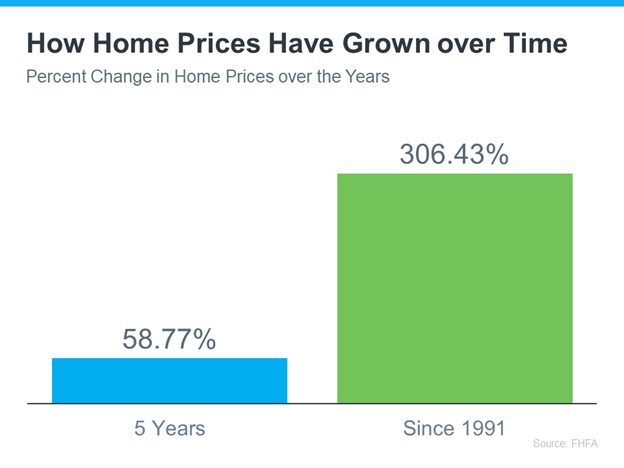
If you have lived in your home for over 5 years, you might just be sitting on a large sum of money that could make your dreams a reality. The recent market has helped homeowners increase their equity by nearly 60% in the past 5 years. Those who have owned their homes since 1991 have experienced their home triple in value since they purchased it back in 1991.
Consideration 2: The Market
Currently, we are experiencing a sellers’ market. Home price appreciation is stable. There is a lack of inventory and a prediction that mortgage rates will decline. We have already begun to see the decline in rates. As rates drop, homeownership becomes an attainable option again for those looking to buy. If you are not currently working with an agent and would like to discuss a strategic plan, connect with us here.
Whether you wish to downsize, move to the destination of your dreams, have the funds to go on the vacation of a lifetime, or move closer to the ones you love, the equity in your home can help get you there.
No matter what your home goals are, a trusted realtor can help you discover the best options to get you there. They can help you sell your current home and get you into the that is right for life today.
Retirement in your future? Let’s connect and explore your options.
Keeping Saltwater In Its Place

Saltwater defines Whidbey Island. We’re surrounded by it. Islands in the ocean are like that. We humans need freshwater, water without the salt. Therefore, keeping saltwater in its place is crucial for survival. Fortunately, Whidbey has freshwater, too. Freshwater flowing into saltwater isn’t usually a problem. The trick is to make sure the flow doesn’t go the other way.
Congratulations if you’re on city water in Oak Harbor
Your water might be coming from off-island. Thanks to Anacortes and the Skagit River, some of Whidbey’s water is piped in from a river that starts in the mountains. Depending on the time of year, you could be drinking recently melted snow. There is not much threat of salt in that water, though there may be minerals, at least at the source.
Look at a map of the island with all its wells marked
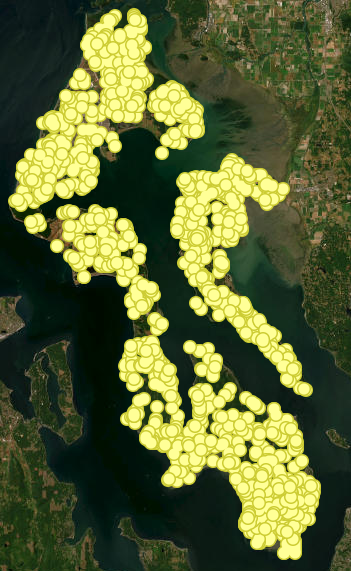
The image is carpeted with icons. For an interactive map click here. Barely any land is left to look at. Dots everywhere. That’s OK. Well water is ubiquitous. Many homes get water from community and municipal wells. Living there can feel no different than the piped water in Oak Harbor, it’s just that the pipe doesn’t have to run as far. One indication that something is different is a sign at the neighborhood’s border that announces whether the water supply is Normal or whether there’s rationing. Droughts happen.
Homeowners in more remote places can have an intimate awareness of their water supply because they have a well on their property. Nicer wells get to live in little houses and sheds that are usually far removed from the house, the septic system, and any other buildings. Here’s where there’s a possible mixing of the waters.
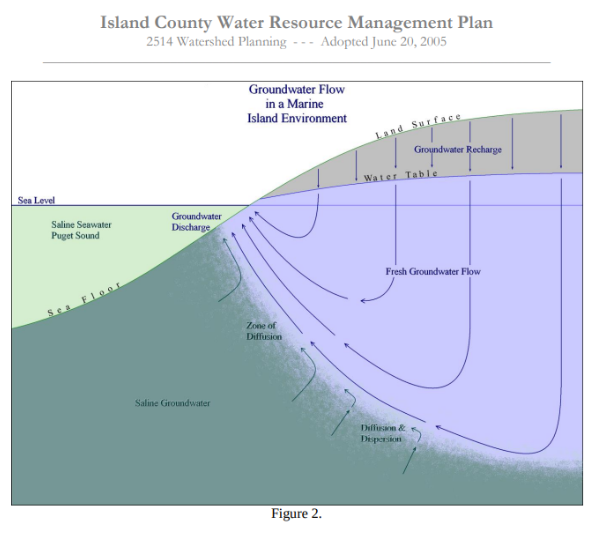
Naturally, rainwater falls, and either runs off the land or seeps through it. Rivers and streams are obvious runoff avenues, but sometimes the rainwater is just below the surface. It still flows, but in broad swathes, not as rivers or streams. Water also seeps deeper, flowing into and filling underground aquifers. It is those aquifers that wells drill into.
What are aquifers?
Aquifers are the unseen reservoirs and streams that collect and channel rainwater naturally. That isn’t just an island thing. Farms in the Great Plains drill into massive aquifers. Island aquifers are smaller. They are also a bit of a mystery. What kind of soil are they under and in? How big is it? How deep is it? How much water is in it? Is there more than one?
Hence, the drilling. For decades, residents who want to build on some land have had to check with the County about whether there is already a well, or maybe one they can try to share, or whether they’ll have to hire a well-digger – and hope.
Why all of this prelude and background?
Each aquifer has a limit to how much water can be drawn from it. It may seem obvious in retrospect, but pump out enough fresh water, and the surrounding saltwater can be drawn in, too. Voila or oops, a fresh water supply can run dry, or turning on a tap pours out salty water.
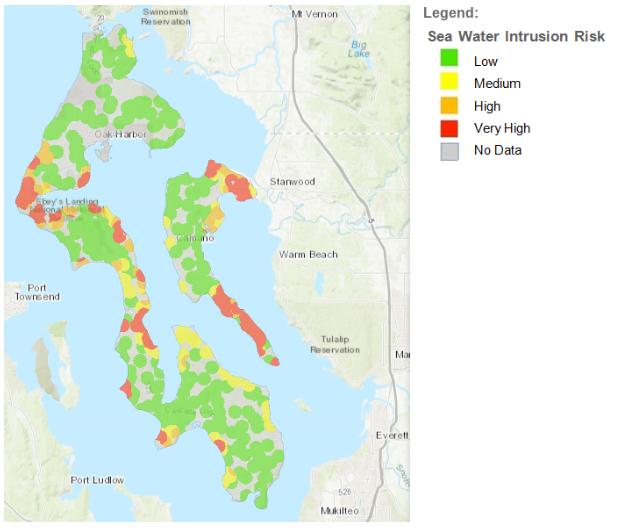
Saltwater coming up a freshwater well was less likely for the early settlers. It could happen if a well was drilled too close to the shore, especially if it was a shallow well. Seawater intrusion is no longer abstract. Look at a map of the island. Click here for an interactive map. A scattering of spots are marked as at risk of seawater intrusion. Some are already experiencing it.
Considerations when purchasing land or a new home
Risk of seawater intrusion can be one reason a neighborhood has to curtail further development. Vacant land can look enticing, but if it can’t access water, then it probably can’t have a livable house built on it. The term ‘water shares’ comes up. So do fees for tapping into restricted supplies. Drilling another well won’t work because it could pull in more of the sea.
Whidbey’s highest point is about 500 feet above sea level. Some wells have drilled so deep that they are hundreds of feet below sea level. And yet, when done right, with the right aquifer, pumped at below a specified rate, there may be no problem. Enjoy your freshwater but, analyzing that map with your broker will help ensure you know where there are concerns and restrictions.
Are there other reasons the water tastes different?
Of course, seawater intrusion is not always the reason water tastes different. Well water is natural. Minerals in the ground are natural. Drinking from an underground aquifer can be flavored by the minerals the water has seeped through. Chefs, cooks, and foodies take note when using natural water and its natural flavorings. It might be an improvement or a reason to buy or get deliveries of filtered water. Some of the minerals and hardness of island water comes from these elements: Arsenic, Calcium, Chloride, Hardness, Iron, Potassium, Magnesium, Manganese, Nitrate, Phosphorus, Sodium, and Sulfate. Household systems can be installed to make the water better match your preferences. Some are as simple as a countertop pitcher with a filter. Others can be systems occupying separate sheds because they’re larger or noisier than an owner wants in the house. Ask your broker who they recommend calling for help.
Are you curious about what’s in your water?
Private and public organizations can test for various chemicals. Your sensitivities will influence your assessment of the water’s quality. Have you ever been encouraged to drink the water as a part of your home inspection? Or even when deciding to write an offer on a property? You should on Whidbey!
The good news is that we know a lot more now than we did before. Within the last few decades, the government has been able to better measure and assess the situation. Guesses are being replaced with answers. Technologies and techniques are being developed that ease the probability of sucking in seawater.
The other good news is that some common sense can make things easier. If the sign says the levels are low, adjust your usage until they recover. It rains here, you know. Trust the rain to water a lawn. Letting your lawn go golden during our dry spells is normal. (Bonus: Less mowing!) Rain catchment systems are gaining acceptance. At the most basic level, use less water. You can benefit, and so can your neighbors.
If you are curious about learning more, or are looking to buy and not currently represented by an agent and would like to work with an agent with extensive knowledge on aquifers and our island connect with us.
Graffiti Wall West Beach
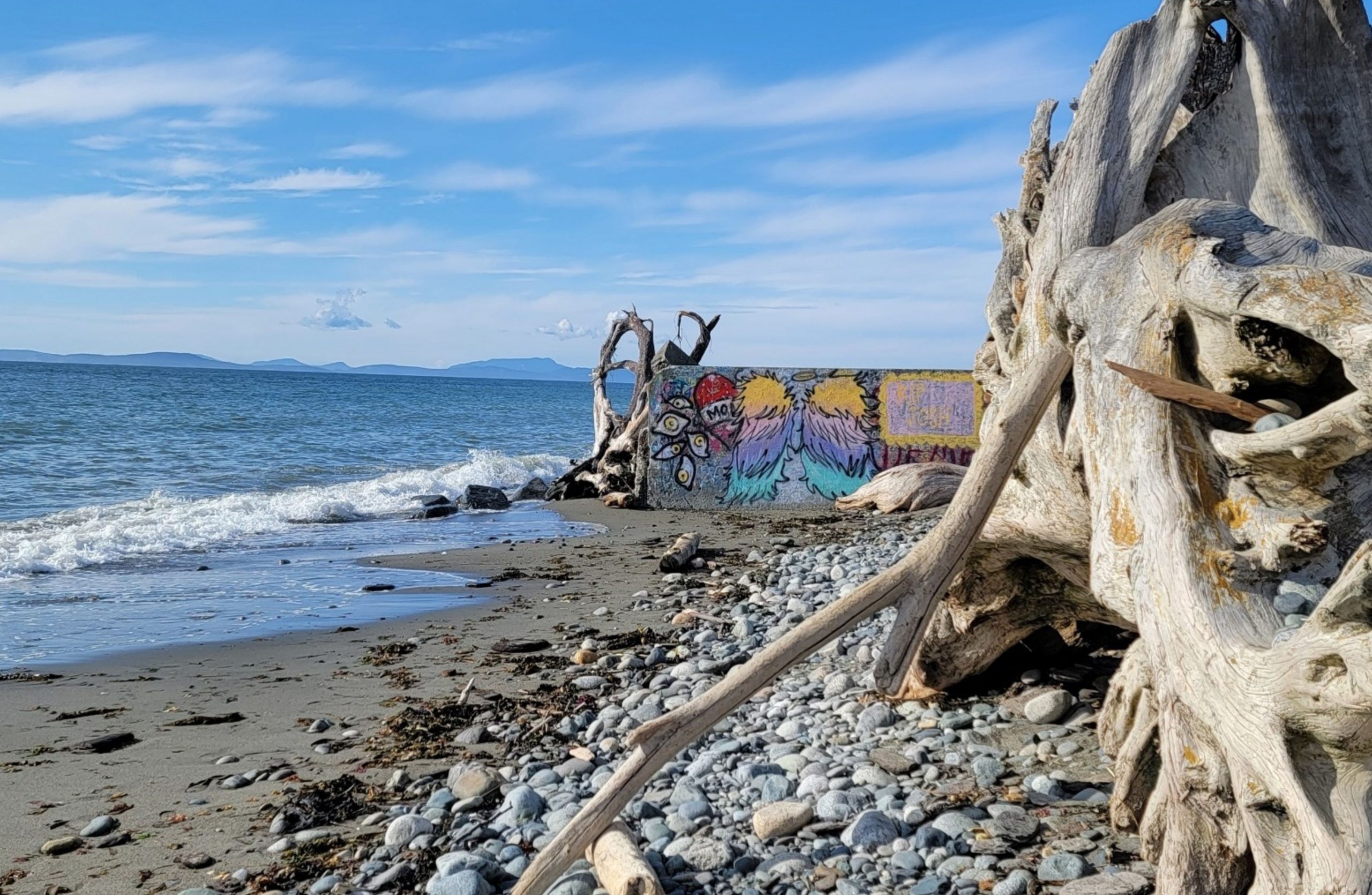
Some call it graffiti while others call it art. Regardless, this iconic Whidbey Island slab of cement that sits perpendicular to the water on West Beach has become quite popular. Next to the West Beach County Park, it is the remains of a mostly washed away Bulkhead. Now, passers-by can enjoy an ever-changing canvas of creativity. While some find it an eyesore and would argue for it to be removed others find it their next photo-op. The destruction of the concrete seawall is a reminder of just how powerful mother nature is. It’s only taken a few years of storms for her to reclaim what was attempted. Winter storms are another attraction to this area. You can watch the onslaught of waves and wind as your car gets drenched in sea spray and flying ocean foam from the comfort of your car.
Check out more about the photographer here.
Check out the rest of Whidbey’s beautiful destinations from this series here.

Weather in the Pacific Northwest

The Pacific Northwest, or PNW, is a region known for its varied and often unpredictable weather. Located in the northwest corner of the United States, the PNW is home to a diverse array of climates and landscapes, ranging from the rainy, temperate rainforests of the coast to the dry, high-desert regions of the interior.
One of the most distinctive features of the PNW weather is the rain. The region is home to some of the wettest parts of the country. Some areas receive over 100 inches of rain per year. While the rain can be a nuisance at times, it is also a vital part of the region’s ecosystem. The rain provides the water needed to sustain the lush forests and vegetation that thrive in the region.
In addition to the rain, the PNW is also prone to fog and mist, especially along the coast. These foggy conditions can last for days at a time, creating a unique and sometimes eerie atmosphere.
Weather on Whidbey Island
Whidbey Island, located in the northwest corner of Washington state, is no stranger to the PNW’s unpredictable weather. Located in the Puget Sound, the island is influenced by both the maritime climate of the coast and the inland climate of the region. As a result, the weather on Whidbey Island can vary significantly from one day to the next. Sometimes a sunshining clear skies day gives way to rain and fog in a matter of hours.
One unique aspect of the weather on Whidbey Island is its location in the rain shadow of the Olympic Mountains. The rain shadow effect occurs when moist air is forced up and over a mountain range. When this happens it causes it to cool and release its moisture in the form of rain or snow. As the air descends on the other side of the mountain range, it warms and becomes drier, creating a “rain shadow” region that receives less rainfall.
Due to its location on the leeward side of the Olympic Mountains, the areas of North and Central Whidbey Island experience this rain shadow effect, resulting in significantly less rainfall compared to other parts of the PNW. While the island still gets its fair share of rain and fog, it is generally drier and sunnier than the surrounding region. Less rainfalls makes it a popular destination for those seeking a respite from the rain.
Despite the often-variable weather, the PNW and Whidbey Island are beautiful and unique places to visit or call home. The diverse landscape and varied climate create opportunities for a wide range of recreational activities. Many people enjoy hiking and camping in the summer to skiing and snowboarding in the winter. So, whether you’re a seasoned resident or a first-time visitor, be prepared for a little bit of everything when it comes to the weather in the PNW and on Whidbey Island.
When you fall in love with the island and want to stay let us help you find your dream home. Connect with us here.
Who are you going to call

Who are you going to call? That’s up to you. How are you going to call? That’s up to you, too; but, that’s a shorter list. It is also easier to talk about. Welcome to Whidbey, or your new home, or your curiosity. Phone service on the island is unique for several reasons; and can even get into international issues. Here are some of your choices.
Landlines:
Landlines exist, and can frequently outperform more modern options. A direct connection between two phones can be clearer, simpler, and make sense in older homes. Landlines can also avoid issues about spots in a house where signals are blocked by things like masonry. They can also be handy during a power outage, if the provider keeps the lines charged. Even better is a provider that buries the lines so they’re less likely to be impacted, literally, by falling branches.
But, landlines have limits. Putting a landline in your pocket can be done, but is somewhat useless when out of range of the home’s base station. (e.g. Whidbey Telecom, Ziply)
Mobile Phones:
Welcome to the modern era when phones in pockets are taken for granted, as is roaming. One phone, one country, that’s pretty good. Cell phones, mobile phones, isn’t that what everyone uses? The major providers are here, which is definitely appreciated. As a solution, mobile phones are the dominant choice.
Mobile phones are the dominant choice, but not every provider can provide unlimited coverage. Can you hear me now? You can still hear people say that on a call as you drive through gaps in coverage. Ridges, buildings, and antenna blind spots can have you checking whether you have five bars, or as little as one bar, or even no bars. Electronic signals can’t be guaranteed to reach the base stations of the corporate carrier. Coverage is pretty good, but a temporary interruption while driving around isn’t as important as a poor signal at home. Check coverage for where you want to live.
Coverage Maps:
Find a home in the areas with your ideal coverage here.
When in doubt, drive there and check. If you are buying a home the home inspection time is a great chance to check cell reception too, make as many calls in as many spaces on the property as possible. If you get the opportunity, check in with the neighbors, possibly on social media, and learn what they use. (e.g. AT&T, T-Mobile, Verizon, US Cellular). Talk with your agent about their experience with coverage. Don’t have an agent? Connect with one here.
VIOP:
Keep in mind, some people want to live in those quiet pockets. There’s someone for everywhere.
Got a good internet connection but no cell signal? VOIP can be an option. Voice Over Internet Protocol routes your calls through the internet, not a phone landline or a cell tower. Some cell phones are already set up to choose the better path between a tower and the internet. That can be the best of both worlds. (e.g. Frontier, Vonage, Wave)
Did That Message Just Say Welcome to Canada?
Hello, Canada. Saying hello to Canada is easy enough. You can see it from the island. Wave at it. Your phone might be doing that too. The farther north and west you get on the island the greater the likelihood that your phone may connect with a tower in Canada. You can get charged for international roaming without leaving the US. Fortunately, your phone should tell you when it does that, but it is worth checking, occasionally. (e.g. Telus)
The Final Message:
The choices aren’t infinite, but there may be more than you want to research for your corner of the island. The denser the population, the more likely you’ll have plenty of choices, many of which run those big national ad campaigns. Our island’s more remote locations, however, can be so unique, so idiosyncratic, that it might make sense to visit and try calling friends and family.
As technology continues to invent new options, the choice continues to change. Now that satellite phones have progressed from specialized Globalstar handheld units to Starlink’s internet access a homeowner can create their own connection, assuming those pesky hills and bills don’t get in the way. If you’ve got power and the right view, you’ve got internet and phone; regardless of whatever might be interrupting everyone else’s day or night.
Who are you going to call? That’s up to you. How are you going to call? That’s up to you, too; but, now you may understand why one answer doesn’t apply to everyone. Thanks, Ma Bell and your old bakelite landline phones wired to a wall; but, we’ve become much more mobile, and hopefully more stylish. Make a call from Whidbey? You’ve got options. Try to call us now: 360.675.5953.
HALLOWEEN IS CREEPING CLOSER

As the crisp autumn air settles in, Halloween is creeping closer and it’s time to conjure up some devilishly delightful pumpkin carvings.
SPOOKTACULAR CARVING IDEAS:
Whether you’re a seasoned pro or a beginner, these spooktacular pumpkin carving ideas are sure to impress.
Start off with a classic Jack-o’-Lantern, featuring a toothy grin and triangle-shaped eyes that never go out of style. Or try a simple yet spooky ghost design with black paint or markers to create a hauntingly eerie look. If you prefer something more whimsical, carve a cute cat with pointy ears and whiskers to add a playful touch to your décor.
But… if you are feeling daring, go all out with a fierce dragon carving. Of course, it will require expert level skill and patience, but it is sure to leave everyone spellbound. For a more elaborate design, try carving a haunted house complete with spooky windows, a creaky door, and ghostly apparitions floating around – perfect for adding an extra eerie ambiance to your Halloween décor.
WHIDBEY ISLAND FARMS:
Once you have your design picked out, head over to one of Whidbey Island’s pumpkin patches to find the perfect pumpkin.
At the Greenbank Farm enjoy a fun day of picking your own pumpkins.
Case Farm offers over 50 years of experience in growing a variety of pumpkins.
While the Bayview Farmers Market has a pumpkin patch, it also offers a variety of vendors selling fresh produce, baked goods, and handmade crafts.
But don’t stop there – Whidbey Farm & Market and The Farm Stand K & R Farms also offer great pumpkin picking options. At the Whidbey Farm & Market, you can support local farmers and artisans while picking out your perfect pumpkin for carving and at The Farm Stand K& R Farms, enjoy a variety of fresh produce and family-friendly activities like a corn maze and ice cream.
HALLOWEEN FUN ON WHIDBEY:
To top off the fun, if you are looking for a spooktacular adventure, head over to the Haunted Barn In Oak Harbor. The haunted barn features creepy decorations, special effects, and live actors sure to send shivers down your spine.
No matter where you choose to pick your pumpkins or celebrate Halloween, make sure to enjoy the crisp fall weather and embrace all the spooky sights and sounds of the season. Happy haunting!
Swimming With And Without A Pool

It is summer, time to jump in the pool! How better to cool off? Autumn? Sure. Get a few laps in before winter. Winter? Soak up some of that warm water from a heated pool. Spring? Summer’s just around the corner, time to get in shape. Swimming pools on Whidbey? It makes more sense the more you think about it. Whidbey is an island, surrounded by water. Don’t ignore it. Jump into it. Safely, of course.
Whidbey Looks A Little Different:
Fly over some neighborhoods in the US and see blue splotches covering backyards with open-air pools scattered among the houses. A few outdoor pools exist on Whidbey, but they’re rarer. Maybe that has something to do with trees and their needles or leaves. Rain doesn’t bother swimmers. And, lightning is rare here.
The most obvious pools may be the ones you hear about but can’t see while driving around. Many pools are indoors, like the one off Midway in Oak Harbor. The Navy base has at least one. Year-round swimming happens.
Visitors may relax in pools if their hotel has one.
Pools on Whidbey:
Between the two extremes of municipal and individual pools are the neighborhood ones. Several neighborhoods come equipped with large pools. Indoor ones may be year-round. Outdoor ones may be more seasonal. If you’re not a resident of that neighborhood, see if you can buy a membership, like at a country club; or, maybe you can buy a recreational lot that is hard to build on, but that grants you amenities.
Each pool has their differences.
- John Vanderzicht Memorial Pool in Oak Harbor is a public aquatic center offering lap swimming, lessons, water aerobics, and recreational swim sessions.
- Island Athletic Club in Freeland is also a fitness club with an indoor pool, sauna, and aqua fitness classes for members.
- Useless Bay Golf & Country Club in Langley is a private country club with an outdoor pool, tennis courts, and golf course for members.
- Admiral’s Cove Pool in Coupeville is a private community pool with a picturesque view of Penn Cove and access for residents that also offers public swimming lessons in the summer.
- Bon Air heated community pool in Coupeville is a private outdoor community pool.
- Scatchet Head in Clinton is a private community pool that is covered and has a view straight south down Puget Sound.
- Sandy Hook Yacht Club Estates is a seasonal outdoor community pool near a marina in Clinton.
| John Vanderzicht Memorial Pool | Oak Harbor | public | indoor | classes, aerobics |
| Admiral’s Cove | Coupeville | neighborhood | outdoor | |
| Bon Air | Coupeville | neighborhood | outdoor | |
| Island Athletic Club | Freeland | club | indoor | classes, sauna |
| Useless Bay Golf & Country Club | Langley | club | outdoor | golf, tennis, dining |
| Scatchet Head | Clinton | neighborhood | indoor | |
| Sandy Hook Yacht Club Estates | Clinton | neighborhood | outdoor | marina |
Personal Pools:
And yes, some houses have outdoor pools, but some have indoor pools. Some even have pools that can be indoor or outdoor depending on whether they roll back a wall.
If you really want that luxury (or necessity for some) of having a pool at your place, talk to the County about building one. Be prepared for permits and lots of rules. Or, find a house for sale that already has one and buy it, the house, that is. If you aren’t already working with an agent and need one to help you search connect with us here.
In Addition to Pools:
Keep in mind though that when talking about swimming you may find people who skip the pools and use nature’s waters. Lakes get you the fresh water experience, without having to worry about tides. Or, use the waters that define the island’s borders, Puget Sound, the Salish Sea, our bit of the Pacific Ocean. A hint, though, find other swimmers and officials who know the currents, depths, restricted areas, and boat traffic issues. And make sure you’ve got the gear and dry clothes for our perpetually cold waters (~50F).
You may not see swimming opportunities until you look for them, but an island in a temperate part of the world can provide plenty of opportunities and options to swim for fun or exercise or both.
If this article got you thinking about moving to a community with a pool or about buying a home with a pool consider reaching out to your agent today to start the discussion. If you are not currently working with an agent and would like to be paired with a trusted realtor connect with us here so that we can get your questions answered.
Boating Around Whidbey

It has been well over 200 years since the waters around Whidbey saw its first sailboat with the explorers of the late 18th century. Just like Captain Vancouver in 1792 people still have the urge to explore this amazing inland waterway from the deck of a boat. Strong currents encourage many to forego sailing in favor of motoring quickly from point A to B. Others like the challenge and quieter method of utilizing the plentiful wind-power. Whichever way floats your boat make sure you get out on the water before the season is over!
Check out the rest of Whidbey’s beautiful destinations from this series here.
View this post on Instagram
Best Ice Cream Spots on Whidbey Island

Whidbey Island, is home to some of the best ice cream spots in the region. Whether you are a resident or just visiting for a weekend getaway, add these ice cream shops to your must-try list.
Whidbey Island Ice Cream Company
The Whidbey Island Ice Cream Company is located in Freeland and has been open since 2008. Their one goal? “To bring joy to our community through the deliciousness of ice cream.” All their ice cream is locally made. Check out their website here before you go.
Kapaws Iskreme
Find Kapaws in the heart of Coupeville. This ice cream spot is only open during the sunny times of the year. Tour the town of Coupeville and stop by this ice cream shop for anything from single-scoops, waffle cones, and cake cones! Bring the eager kids who love combining all the different flavors – a must-stop spring/summer ice cream location. Check out their Facebook here before you go!
The Farm Stand
The Farm Stand ice cream on Whidbey Island is a locally made treat using the freshest ingredients from the surrounding area. With a variety of flavors to choose from, each scoop is a unique and delicious experience. Enjoyed at the Farm Stand or taken to go, this ice cream accurately represents Whidbey Island’s bountiful offerings. Learn more about the Farm Stand here before you head out.
Whidbey Farm & Market
Whidbey Farm & Market ice cream is made with the freshest, locally sourced ingredients to provide the best possible flavor and quality. With a wide range of flavors, they are dedicated to creating a memorable experience with every scoop. Whether enjoyed at the farm or taken to go, Whidbey Farm & Market ice cream is a treat like no other. Check out their website here.
Popsies
Grab a cone from this unique dedicated candy store on pioneer street in Oak Harbor while you walk the strip and browse the other local shops downtown. Check out their website here.
No matter which ice cream spot you choose, you’re sure to find a delicious treat on Whidbey Island. These ice cream shops are the perfect way to cool off on a hot summer day and experience a fun outing with friends and family. Share your adventures with us at @windermere_whidbey_Island on Instagram.
5 Reasons to Use a Local Lender

When it comes to buying a home, choosing the right lender is an important decision that can have a significant impact on your home buying experience. While it’s possible to work with a lender from anywhere, working with a reputable local lender in the area you are purchasing provides many benefits that make the process smoother and more enjoyable. In this article, we will share five reasons why you should consider using a reputable local lender for your next home purchase.
5 Reasons to Use a Reputable Local Lender:
1. Personal Connection:
A local lender provides the opportunity to have a face to face conversation and build a personal relationship, which can be especially helpful when dealing with complex issues. How much better is it to have the ability to sit down face to face with someone and discuss, ask questions, smile and laugh with or even cry if necessary? It is so much better than trying to solely do things over the phone or email with someone hundreds of miles away. When the going gets tough, you (or your trusted real estate broker) can go directly to the office and discuss the issues in person to figure it out rather than be put on hold.
2. Knowledge of the Market:
A local lender is more likely to have a deep understanding of the local real estate market, including contractors, permit requirements, and more. It is not unheard of to have a local lender provide contact details for a roofer that can get the fix done in time for closing or the local Labor and Industries permit guy who can solve the problem faster than driving an hour to the nearest office. Reputable local lenders understand when there is delay due to septic repairs or how to get the water quality test results ASAP.
3. Reputation:
Local lenders have a reputation to uphold in their community, which can provide added accountability and ensure a higher level of service. When you run into your clients in the grocery store or watch their kids play on the same soccer team you naturally put a little more into making sure your service is impeccable. Anonymity creates distance and reduces accountability.
4. Strong Relationships with Escrow Teams:
Good relationships with local escrow teams can lead to smoother and more efficient transactions. Often the most stressful point of the transaction is right at the very end as the final underwriter is reviewing the file and potentially finding issues that need more documentation. This can lead to delays in critical milestones that need to be met to close on time. Getting the necessary documents from the lender to escrow on time can be the difference in closing as expected or experiencing costly delays and even the possibility of losing the home. You can use a lender from almost anywhere, but the escrow team is nearly always local to the property being purchased. When lenders are well known and respected by the local escrow offices you can expect excellent communication and problem solving between them. This will make overcoming obstacles to closing on time more likely.
5. Competitive Terms:
Local lenders often offer competitive terms and rates, making them a cost-effective option. When comparing lenders, be sure to compare all the terms and costs of the loan, not simply the advertised interest rate. When you do, you’ll often find the local lender has lower overall costs than national corporate lenders.
In conclusion, using a reputable local lender provides a range of benefits that make the home buying process more enjoyable and efficient. From the personal connection to the knowledge of the local market and their reputation to uphold, there are many reasons to consider using a local lender for your next home purchase. So why not choose a lender who is well-known and highly regarded in your local real estate community? Contact us today to be put in touch with a great lender on Whidbey Island!
